
Car guides / Mitsubishi
1992 Mitsubishi 3000GT VR-4
See how the 1992 U.S. 3000GT VR-4 moves its front air dam and rear spoiler together, when the system deploys, and how it differs from four-wheel steering.
Open the 3000GT scanner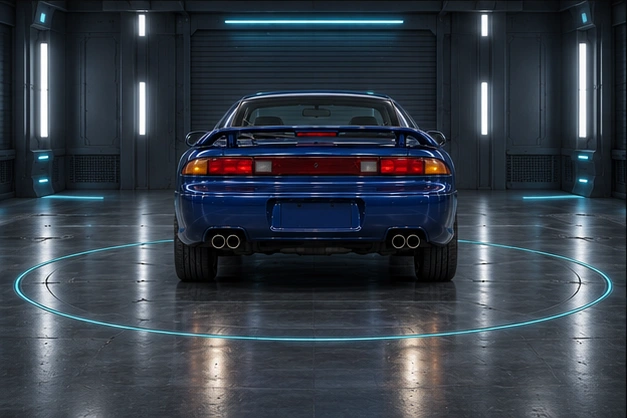
- Market
- United States
- Engine
- 3.0 L twin-turbo V6
- Rated output
- 300 hp
Two moving parts, one system
The 1992 U.S. VR-4 controlled airflow at both ends of the car. At the front, a motorized air dam extended downward under the nose. At the rear, the spoiler changed its angle. From behind the car you can see the wing, but that view tells only half the story. The scanner’s front air dam marker takes you to the other half.
Find the front air damWhen Active Aero moved
Mitsubishi’s 1992 U.S. brochure gives 50 mph as the deployment speed. The front air dam lowered 80 mm and the angle of the rear spoiler increased by 14 degrees. Both returned to their resting positions below 31 mph.
That gap explains why a single speed is sometimes an incomplete answer. At 40 mph, a car accelerating from rest and one slowing from highway speed could have different spoiler positions. The scanner marks the hardware on a stationary illustration.
Inspect the active rear spoiler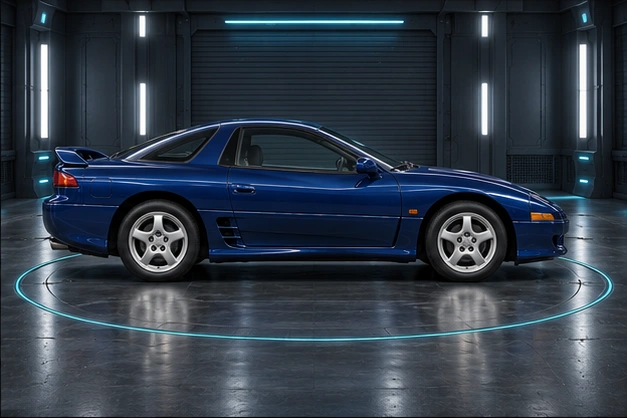
Active Aero, four-wheel steering and AWD
Those three names describe different jobs on the same car. Active Aero positions the bodywork to manage airflow. Four-wheel steering changes the direction of the rear wheels as well as the fronts. Full-time all-wheel drive delivers engine torque to both axles. In the scanner, the rear steering marker sits at the wheel and the aero marker sits above the tail.
Locate the rear steering marker